Sunday, July 29, 2012

Olympics: A time for bonding, not dividing, as Americans


When it comes to our daily lives, we stand divided on many issues, everything from gun control to guys and girls on 'The Bachelor' or 'The Bachelorette.'

But every two years, the Olympics mark a time we can come together. As Americans, as families, as friends, we all share a common bond. Our rooting interest is the same, which doesn’t happen too often. 

Rivalries in sports often divide friends, cities and families. That’s part of the fun. We love trash talking a friend, brother or cousin when our team beats theirs. We thrive on seeing our teams take titles. But in doing that, we become a segmented audience. 

Not so with the Olympics. 

For two weeks, we can all root for the same athletes, representing our country among the world’s best. 

The Olympics brings us all together for a good reason and that proves a rare occurrence. Many times, it's tragedy that causes us to seek unity and patriotism. 

Post-9/11, flags flew outside of homes and bars. The fabric at the heart of our country became stitched even tighter.

It’s easy to sometimes forget what makes our country so special -- the freedoms that we are afforded, the values upon which we live our lives.

We remember them when they are tarred and corrupted, like last Friday, when a gunman entered a movie theater, shooting 71 innocent people, killing 12 in Colorado. They were just trying to enjoy a midnight premiere. It’s simple, just another ritual for Americans. 

In the aftermath of that tragedy we remembered just how fragile life is, just how tenuous our freedoms can be. It's when our cores are shaken when that perspective takes focus. As Colorado victim Jessica Redford so poignantly wrote following another shooting she narrowly missed, "I was reminded that we don't know when or where our time on Earth will end. When or where we will breathe our last breath." 

We came together in support of those victims, people like us, whose lives were taken in tragedy. 

But now, we get the opportunity to come together for good reason as the 2012 Olympics kick off in London. We won’t find strength in each other through pain and suffering, but triumph and success. 

We’ll sit on our couches watching it all unfold, with family and friends. 

I remember it when I was a kid, sitting in my living room with my grandma, eyes glued to the television as Kerri Strug hopped off the mat in Atlanta and the Magnificent 7 hopped on to the podium, gold put around their necks. 

In 2008 at Beijing, Michael Phelps captivated the world. My friends and I screamed as we huddled around the TV watching Phelps reach for the wall, tempting fate with fingertips in the 100-meter, keeping alive his quest for most Olympic medals. 

Two years ago, I sat in my friend's dorm room watching hours of curling at the 2010 Vancouver Winter Olympics, as we came and went from class to class. 

It’s all incredible. And there's something for just about everyone. Some marvel at the sheer speed of swimming's sprints, others the artistry of gymnastics, and for some the bikinis of beach volleyball are enough reason to tune in.

We feel the thrill of the games -- Americans, free just like us, on the world’s biggest stage. 

The Star Spangled Banner plays as we watch them revel in their moment of glory. They get choked up. Sometimes we do too. And we do it together. 

For a couple weeks, we see the commonalities we share with each other and the rest of the world. Despite different governments, ideologies, or ways of life, we are all people. 

We’re not divided like lawmakers on Capitol Hill. We’re not broken apart on hot-button issues. We're not liberals or conservatives, activists or pacifists, when it comes to the games. 

We are people. We are Americans.

That's the power of the Olympics. 


No, the games aren't without scandal or imperfections, but their power to unify is undeniable. So grab a friend, settle in with family, and together, watch the flag unfurl and history unfold.

Read more: http://www.newsnet5.com/dpp/sports/olympics/2012-london-olympics-a-time-for-bonding-not-dividing-as-americans#ixzz221o15cse

Wednesday, June 27, 2012

Aaron Sorkin's 'newsroom upon a hill' in new HBO series 'The Newsroom'

If you didn't know the news was a shell of its former self, well, Aaron Sorkin isn't just telling you in his new HBO series The Newsroom. He's hitting your over the head with a stack of papers, running it on a crawl and flashing it all over your television screen in the same way today's news coverage he looks down upon would probably handle a celebrity death.

The Newsroom is very well-cast. Jeff Daniels is compelling as news anchor Will McAvoy, who strives to be objective but ultimately breaks routine with an outburst that triggers attention. Executive producer Mackenzie Machale, played by Emily Mortimer, is wonderful, plucky and full of life. Mortimer and McAvoy have excellent chemistry. Senior producer Jim Harper (John Gallagher Jr.) and newly named associate producer Maggie Jordan (Alison Pill) are likeable, the initial newsroom underdogs you want to root for.

But for all the good the actors can do, The Newsroom is bogged down in its own self-worth, smothered in idealistic dialogue and predictable setups. Let's spell it out in episode one.

- New EP hired, anchor doesn't want to work with her team, breaking news happens, they conveniently prove themselves
- New EP and anchor had a past relationship (surprise!) that carries baggage they must work through
- Anchor 'imagined' new EP in audience when having diatribe but shocker it actually was her! And in case you didn't catch on it's made astoundingly clear.

Sorkin's 'newsroom' is one where the news cycle is dictated by the color of AP alerts. It operates in a fictional reality where an entire hour-long newscast goes over seamlessly with no rundown. A phoner is cued up 30 seconds before air and runs without technical glitch.

Yes, this is television. It's not always realistic. No one believes counterterrorism agencies really run in the same manner as CTU did in 24 - at least I hope not.

That was fine - the willing suspension of disbelief worked because of the show's tone. 24 was always pure entertainment, a thrill ride which made no bones about its existence outside of actual reality. Whereas 24 was centered around fictional terror plots, The Newsroom focuses on fictional coverage of a pulled from the headlines story, the BP spill in the Gulf. That makes the liberties taken with being realistic harder to swallow.

Sorkin's newsroom is his version of a 'city upon the hill,' a newsroom more virtuous and grounded in the truth than all others. The excellent actors are given dialogue that's so coated in Sorkin's predisposed agenda that they can't help but sound like a class president reading a speech of promises to the high school auditorium.

The Newsroom is not a bad show. The 73 minutes start off with a bang, fall into boredom, then crescendo again into a fast-paced product. But even its funny moments are spoiled by a lack of overtness, the need to spell out just what is meant.

As the "perfect" live newscast is going off, the older news director Charlie Skinner emerges and tells a young lady to get on her Twitter and describe how wonderful it all is from his long-winded speech.

That's a funny bit. You could see that happening in a newsroom - I got a laugh out of it. Until the woman responds woodenly "I can only use 140 characters." Way not to spell that one out.

And that is perhaps the greatest flaw of The Newsroom. It is just too full of itself. The show treats its viewers like they are the idiots who don't know that the news is "so bad."

While entertaining at times, it comes across as the professor who does not describe history but instead stands upon a pulpit and preaches the way it should have been.

Even worse, The Newsroom becomes just what Skinner does not want his newscast within the show to be - an agenda.

Sunday, June 17, 2012

Special Father's Day for Dale Earnhardt Jr. and Rick Hendrick

A father who lost his son on his way to the track and son who lost his father on it both tasted victory Sunday on Father's Day.

Dale Earnhardt Jr. was on the phone with his boss Rick Hendrick before he stepped out of his car in Victory Lane. It was Earnhardt Jr.'s first time there in 143 races and four years.

Earnhardt Jr. was born into a racing family, now in its fourth generation. It began in Kannapolis, North Carolina with Ralph Earnhardt and now stretches all the way to Jeffrey Earnhardt, who has made two NASCAR Nationwide starts in 2012.

Dale Jr.'s whole life has been racing, growing up watching his dad win races and championships. Jr. grew up with his father on the track and also lost him there. It was as he pushed his Dale Earnhardt Incorporated teammate Michael Waltrip to the 1998 Daytona 500 win that his father's car crashed into the Turn 4 wall.

Earnhardt Sr. was pronounced dead that day, at a hospital outside the mecca of motorsports.

Rick Hendrick created his racing family. Hendrick built his first car as a tween, became a team owner in 1984 and has since won numerous championships. His son Ricky followed in his father's racing footsteps, first as a driver then as an owner.

But like Dale Jr.'s dad, Hendrick's son was lost in the pursuit of his passion. Ricky Hendrick died in a plane crash on his way to Martinsville Speedway in 2004.

Nine people associated with Hendrick Motorsports died in that crash, including Rick Hendrick's twin nieces.

"Everybody on that plane was special. And there'll always be a hole in your heart for all of them," Hendrick told USA Today in 2005.

Dale Jr. and Rick Hendrick are two men whose lives are each entrenched in the rubber of the racetrack and the family bonds created through them. Each suffered great loss associated with what they love.

Sunday a black Chevy was back in victory lane. It was driven by Junior on a day reserved for fathers. You can't help but remember Dale Sr.'s black No. 3.

Earnhardt Jr. and Hendrick aren't bonded by blood but Junior delivered Hendrick a  Father's Day gift - and you can only imagine, somewhere up above, the father and son they lost were casting down smiles. 

Sunday, June 3, 2012

Craig Sager interviews Kendrick Perkins Jr. who likes pie

Craig Sager is well-known for his ghastly fashion statements on TNT's NBA broadcasts. He has interviewed some of basketball's best but it was an interview he did with a young tyke Saturday night that was television gold.

Following the Thunder's game four victory over the Spurs, Sager caught up with Kendrick Perkins Jr., the son of Thunder center Kendrick Perkins.

He asked him thought-provoking questions such as "why are you dressed like Russell Westbrook?" but struggled to get much of a response - until it came to a question about, you surely didn't guess it, marshmallows. 


Get that boy some pie! (not Sir Charles though - he's on Weight Watchers, remember?)

Saturday, June 2, 2012

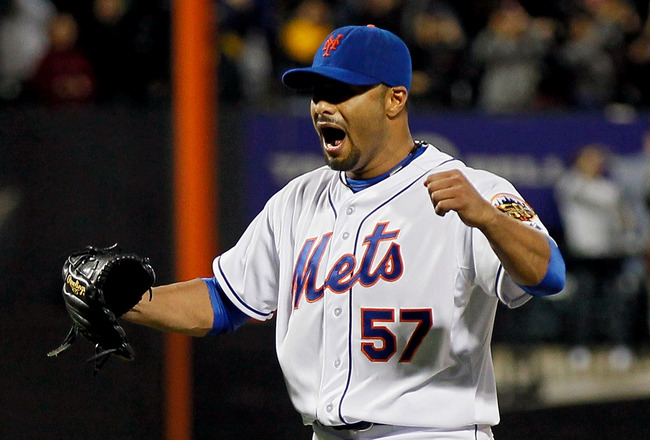
Johan Santana's no-hitter erases glaring zero in Mets' history

Baseball is a game of numbers, made up of many minute statistics. Its greats and milestones are defined more than any other by mythical numbers (some of which have since been tarred).

755, 62, 2632, 56 - if you’re a big baseball fan, there’s no need to match those numbers to name or feat.

For the Mets, a lengthy streak lingered in their 51-year history.

8,019 – that’s the number of games, now well known, the Metropolitans had gone without a no-hitter.

30 franchises had pitched a no-hitter in their history in that time, the Mets and Padres the lone two left out of that club.

Four Cy Young awards were given to two Mets pitchers, Tom Seaver three times and Doc Gooden once.

Four Mets pitchers finished the season with the lowest ERA in baseball seven times (Seaver again did it three times).

Seaver, Gooden and David Cone combined for nine strikeout titles.

Five different managers earned the Mets six playoff berths. Four won pennants. Two won World Series championships. 

Mets pitchers threw a total of 35 one-hitters.

None threw a no-hitter.

Friday night, a zero in the hit column erased that zero in the record book, accompanied by a new set of numbers.

134 pitches by two-time Cy Young winner Johan Santana, 19 more than manager Terry Collins said was his limit.

Two defining plays - a Carlos Beltran liner that was called foul though it left a mark on the chalk down the third base line and an incredible catch by a Queens native, Mike Baxter.

27,069 fans who witnessed history.

One no-hitter.

It’s not a World Series. It doesn’t rectify the chokes or disappointment Mets fans have suffered over the past decade.

But for one night it brought life never before seen to Citi Field, celebration on the mound, and euphoria in the stands.

You can’t measure that in a number - only in feeling.

Monday, May 14, 2012

EPL and MLB final days prove not just playoffs produce drama

One kick Sunday culminated nine months of competition. Not much in sport is more old school than that.

The final day of both the 2011 MLB and 2011-12 English Premier League proved you can have immense, unforgettable drama outside a playoff setting.

The push in every sport over the past couple of decades has been the more playoff games, the better.

MLB expanded its playoffs first to include one wild card and now a second starting in 2012. The NBA and NHL each have eight-team playoffs that stretch on for what seems like a whole other season. NASCAR went from a point system that rewarded a full season of consistent success to one that crowns a champion based on ten races.

The self-imposed idea furthered by sports leagues is that excitement won’t truly be palpable until playoff games begin.

Unforgettable endings for MLB and EPL regular seasons put that assertion as rule to bed.

For the EPL, it was the months-long battle for the title that came down to the season’s final Sunday. Manchester City needed to beat Queens Park Rangers to win its first title in 44 years over rival Manchester United.

38 matches and a chance at unprecedented glory came down to five stoppage minutes for City. Back against the wall, it looked all but over, down two goals as the 90th minute hit. In five minutes, though, the way a season’s worth of history will be written dramatically changed.

An equalizing goal, then with just two minutes left, Sergio Aguero’s strike to deliver City the 3-2 lead it needed to eclipse Man U for first.


It was no playoff. Instead it was a season’s worth of back and forth that reached a thrilling climax naturally.

Much was the same in baseball about eight months ago, a season’s worth of trial and tribulation hinging on the 162nd game for four teams.

Two controlled their own outcomes.

Boston and Atlanta lost, punctuating historic collapses. Tampa Bay and St. Louis punched tickets to the playoffs. The Cardinals carried their finish all the way to a World Series.

All that drama percolated on four different fields, four opposing teams with nothing but pride and a chance to play spoiler on the line.

Sure, playoffs do undoubtedly create great moments. With the pressure at a fever pitch, improbable, compelling moments happen.

Some sports, like college football are sorely in need of a playoff, kicking to the curb arbitrary ratings and polls to determine a No. 1 vs. No. 2 title matchup.

However, forcing more playoff games down fans’ throats only diminishes what makes them special. Adding a one-game playoff to a season that spans 162 games is illogical milking of the concept.

That’s right, Bud Selig.

Your magical 2011 game 162s should have taught you that drama often just falls into place, everything building up to a story you couldn’t write. Putting two teams in a winner gets in playoff doesn’t replicate that. In fact, in 2011, it would have spoiled it. Boston, Tampa, Atlanta and St. Louis may have sat their starters in those game 162s, all assured a wild card spot.

Sports drama is not some kind of chemistry experiment. It cannot be mixed together in a lab or owners’ meeting.

It just happens.

You never know just which day will live on in lore – every one is worth watching.

Thursday, March 29, 2012

Groce wakeup call as coach heads to Illinois


My subconscious was talking.

Last night, I had a dream about the Bobcats that didn’t really make sense. Ohio was in the MAC Championship at a convention center, definitely not the Q. There was a band, but definitely not the 110. And my friends were there (they actually were my real friends).

Just like that, I woke up to my 3:15 a.m. alarm for work. Never saw what happened on the court or how it played out for Ohio.

Many Bobcats fans woke up to the news Thursday morning that John Groce would be the next head coach of the University of Illinois.

Just like that, the Groce era was over.

It took only 48 hours for fans to be pulled down from the high of Ohio’s first Sweet 16 appearance since 1964. That was when the talk of Groce to Illinois began.

Thursday afternoon the whirlwind of what was called 'GroceWatch' – and Groce’s Ohio tenure- came to an end when Illinois officially announced him as its next head coach.

While his time in Athens was short, Groce’s impact was significant.

He made the NCAA Tournament twice in three years and won three games. The Bobcats had four tournament wins in program history before that.

Groce will make much more money at Illinois, $1.4 million a year for five years. He’ll go to a Big 10 program with the big name and pedigree. It's an offer too good to pass up. There’s no way to fault his decision. It’s just a cold, hard reality of being a mid-major.

Now, Ohio must figure out its next move. It has the momentum of the Sweet 16 berth and greater exposure on its side.

There are multiple routes the Bobcats can go. Possible candidates are current Ohio assistant Dustin Ford and Ohio State assistant Jeff Boals, both Ohio grads.

The Bobcats would be in good hands with either of those choices.

However, there's still that feeling of waking up from a dream for Bobcats fans, one that ends with a D.J. Cooper missed three at the buzzer.

That's the ringing of your alarm. You wake up, but never find out how Groce's 4th season at the helm, with everyone back, turns out.


You just continue on with reality.